

What’s the Difference Between an AI Chatbot and a Traditional Chatbot?
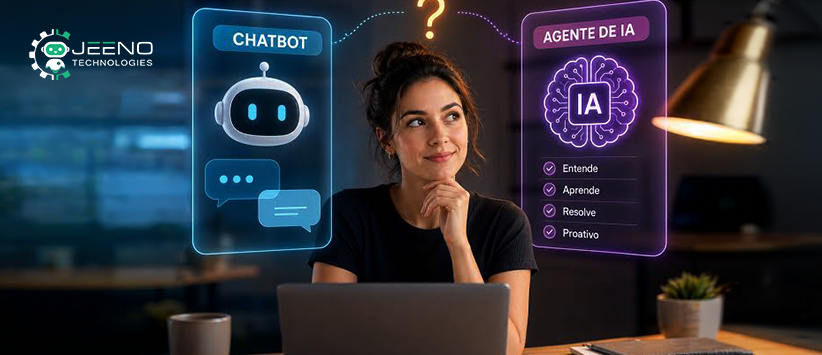
Table of Contents
A comparison study about AI and traditional chatbots
Artificial intelligence is transforming how a company manages workflows and customer support services. A website with traditional chatbots that was once limited to just a knowledge-sharing platform has now transformed into a major lead-qualification and conversion point with the introduction of AI website chatbots. Also, customers nowadays expect more from your customer support services since they need personalized experiences.
In this blog, we will look into the difference between traditional chatbots and AI chatbots and how AI chatbot development services bring the most value to your business.
What is a traditional chatbot, and what tasks can they do?
A traditional chatbot works under a rule-based system. Developers ideate the questions the customers tend to ask repeatedly and have programmed the chatbots to answer only those queries.
This basic chatbot doesn’t understand the context and provides generic responses. For non-programmed queries, it will ask the user to connect with a human support agent.
The traditional chat assistants give answers on the basis of
- Keyword recognition
- Scripted replies
- Rule-based workflows
- Structured conversation paths
If a user asks a query that doesn’t follow the above, the chatbot fails to provide valuable support
Types of traditional chatbots
Menu or button-based chatbots:
These are extremely rigid and are suitable for answering scripted FAQs.
Rule-based chatbots:
Interpret text typed in a specific format and are best for simple troubleshooting guidance.
Keyword-based chatbots:
They look for specific words in the queries and respond accordingly. They are used for viewing information.
How does an AI chatbot function?
AI chatbots simulate human-like conversation using machine learning and natural language processing. AI chat assistants give context-aware responses in natural language, understanding text or voice inputs.
A trained AI chatbot with Retrieval-Augmented Generation (RAG), knowledge base integration, guardrails, and response validation can understand user intent and generate relevant responses without hallucination
Types of AI-powered chatbots
AI voice assistants: They offer spoken communication in areas like customer support, call centers, appointment booking, and more.
Website AI chatbots: These can be embedded on websites to provide 24/7 customer support and instant responses for customer queries.
Generative AI chatbots: Produce highly personalized responses for even complex queries.
Differences between traditional chatbots and AI chatbots
Recognizing user needs
Traditional chatbots can provide responses to users only if they input queries in a predefined format. They give scripted answers and are not capable of changing answers even if the user intent doesn’t match.
AI chatbots understand user needs and generate replies relevant to them. They do not use already written answers; instead, they retrieve information from the business’ knowledge base.
Learning from responses
Traditional chatbots cannot improve by learning from interactions. Their answers are rigid and cannot be modified.
AI chatbots learn from conversations and improve their performance. They can generate highly accurate and personalized replies for user queries.
Response quality
Conventional chatbots provide responses that appear to be robotic. They follow a strict response path, and customized answering capability is limited.
AI-powered conversations look natural and human-like. So customers feel free to interact with the bots without being concerned about strict rules.
Personalization
Traditional chat assistants create a generic response. Due to their capability constraints, they are unable to produce personalized answers.
AI chatbots refer to interaction history, customer behavior, and preferences to customize interactions. AI assistants with product recommendation engines in the back end work as efficient sales representatives for your business.
Scalability
Because of their restricted capabilities, traditional chatbots are unable to adjust to changing circumstances as your firm grows and the volume of work increases.
Artificial intelligence chatbots are designed to handle interactions at scale across various channels with only nominal manual effort.
Know the benefits of traditional chatbots for businesses
Basic chatbots, even though they don’t have advanced features, are useful in the following ways.
- They are more affordable and less expensive to construct.
- Traditional chatbots can be deployed easily even under limited support capabilities.
- They are useful to carry out simple, basic tasks like answering FAQs and booking appointments.
Know the benefits of AI chatbots for businesses
Many industries are approaching AI chatbot development companies to create customized AI virtual assistants to support their business activities like sales and customer support. Some of the top benefits of intelligent chatbots are
- AI chatbots (RAG-powered) retrieve data from your business resources to deliver accurate and grounded answers to consumer inquiries.
- They offer 24/7 customer care assistance, handling customer interactions in real-time.
- They analyze leads and qualify them quickly. Route them to the sales team for further course of action.
- The AI-powered intelligent chatbots offer insights to help businesses make better decisions.
Read our detailed blog ‘Top 10 benefits of using AI chatbots on your website’ to know more.’
Tips: If you have a limited budget and need only basic automation, traditional chatbots would be a fit.
For advanced automation and growing support needs with personalization, AI chatbots are beneficial.
Stop giving repeated answers to your customers. Let AI chatbots handle customer conversations and offer personalized responses.
Jeeno offers the best AI development services to build custom AI chatbots. Our solutions offer accurate, trustworthy, and highly personalized responses, building customer trust and confidence.
AI chatbot use cases
- Respond to consumer inquiries at any time, even after business hours.
- Recommend products, collect leads, and guide customers through the buying process.
- Answer frequently asked questions so your team can focus on more important tasks.
- Get better over time by learning from past customer conversations.
- Reduce waiting time by providing quick and accurate answers.
- Work with CRM and other software to manage customer information more efficiently.
- Automate routine activities to increase team productivity.
How different industries benefit from AI chatbots
AI chatbots for the healthcare industry
- Appointment booking
- Patient help and guidance
- Medical information management
AI chatbots for E-commerce and retail businesses
- Customer support services
- Order and shipment tracking
- Product recommendations
Real estate AI chatbots
- Sales and customer service support
- Answer property inquiries and showcase property listings
- Lead qualification
AI chatbots for manufacturing industries
- Share product information
- 24/7 customer support
- Support multiple languages to deal with international customers
AI chatbots for law firms
- Task automation
- Legal consultation booking
- Share case status updates
AI chatbots in banking
- Help with the loan application procedure and eligibility pre-screening
- Assistance for insurance claims
- Recommend financial products, credit cards, etc.
AI chatbots for IT firms
- 24/7 IT help desk support
- Answer product- and service-related queries
- Track support ticket status
Conclusion
As we said earlier, there are many chatbot options available. But choosing the one for your business depends on the budget and how you want to serve your customers.
When you choose a chatbot, be sure that it should not be the one that gives only fixed answers. Instead, the chatbot should make conversations more personalized and save time by reducing manual efforts and providing quick support.
A trusted AI chatbot development service provider like Jeeno can help you create the best chatbot solution to improve customer service and make daily tasks easier.
Know more about Jeeno
Jeeno Technologies is a leading AI solutions provider for businesses operating across various countries. Here are some reasons why you should choose Jeeno for your AI chatbot development needs.
- ISO 9001 and ISO 27001-certified AI consultancy
- End-to-end services from AI consulting to AI chatbot training services
- We create responsible AI models with custom guardrails to control responses and AI actions.
- Easy integration into existing setup.
- We deliver tested and validated AI chatbots.
Want to know more about our team capabilities, infrastructure, and quality policies? Visit Jeeno Tech.
Read answers to the most common questions about AI chatbots
What are the different chatbot types?
Chatbots are categorized based on how they work and interact with users. Businesses can choose the right chat assistant depending on their needs, level of automation, and customer expectations.
Rule-Based Chatbots
AI-Powered Chatbot
Voice Chatbot
Hybrid Chatbots
What is the main difference between the AI chatbot and conversational AI?
AI-powered chatbots use natural language processing and machine learning to interpret user inputs and provide reliable answers.
Conversational AI is a vast technology that enables context-aware natural responses by understanding emotions and user intent.
Are all AI chatbots secure enough to use for business purposes?
The safety level of AI chatbots depends on how they are designed and trained. Proper integration and maintenance also play an important role. Jeeno applies advanced AI security practices to build highly safe and scalable AI chatbots.
Encryption
Authentication
Access controls
Data privacy measures
Monitoring
AI guardrails
Categories
- Agentic AI 04
- RAG 01
- AI Governance 02
- Artificial Intelligence 08